
Quote in 48 hours
Scope your CMMC pentest
C3PAO-ready evidence for CA.L2-3.12.1. Quote in 24 hours.
Originally published: February 14, 2026 · Last updated: June 4, 2026
Phase 2 CMMC enforcement begins November 2026. Defense contractors handling Controlled Unclassified Information (CUI) must hold C3PAO certification before bidding on most affected DoD contracts. If you haven’t scheduled your penetration test, you’re already behind.
CMMC enforcement is no longer a future planning exercise. It is a contract requirement with a fixed deadline, and the Department of Defense has made it clear that contractors who cannot demonstrate certification will lose access to a substantial portion of the defense market. A penetration test is not the box you check at the end of the program. It is the evidence layer that proves your documented controls actually hold up when a real adversary applies pressure. This guide is for defense contractors who need to get CMMC penetration testing right before Phase 2 hits, written from the perspective of what C3PAO assessors actually look for in the report.
What CMMC Actually Requires for Penetration Testing
CMMC defines three levels of cybersecurity maturity. Pentesting conversations primarily happen at Levels 2 and 3 because those are the levels that involve Controlled Unclassified Information. The expectations at each level differ, and conflating them leads to over-scoping or under-scoping the engagement.
- Level 1 covers foundational controls for Federal Contract Information. Penetration testing is optional here, but a focused external test of internet-facing exposure is still useful for validating basic hygiene.
- Level 2 is aligned to the 110 practices in NIST SP 800-171. Most organizations in the Defense Industrial Base treat penetration testing as a practical requirement to validate control effectiveness before C3PAO assessment, even though it is not explicitly mandated at this level. Assessors expect to see credible evidence that controls operate as documented.
- Level 3 covers higher-risk programs with advanced persistent threat considerations and is assessed by the Defense Counterintelligence and Security Agency. Penetration testing is a strong expectation here because the maturity bar is significantly higher and the threat model assumes capable adversaries.
The most important distinction to internalize: vulnerability scanning is not penetration testing. Scanning finds known issues at scale. Pentesting validates exploitability, chains weaknesses across systems, and demonstrates real blast radius toward CUI. C3PAO assessors can tell the difference within the first few pages of a report, and submitting one in place of the other is the fastest way to raise questions about the entire control set.
CMMC Level 2 vs Level 3: How Testing Requirements Differ
The right testing approach depends on which level you are pursuing and the nature of the CUI you handle. Both levels require careful scoping, but the depth, methodology, and reporting expectations diverge significantly.
Level 2
- Aligned to NIST SP 800-171 and its 110 practices
- Assessed by a C3PAO or self-assessed depending on contract type and CUI sensitivity
- Penetration testing validates that controls documented in the System Security Plan are actually operating as intended in production
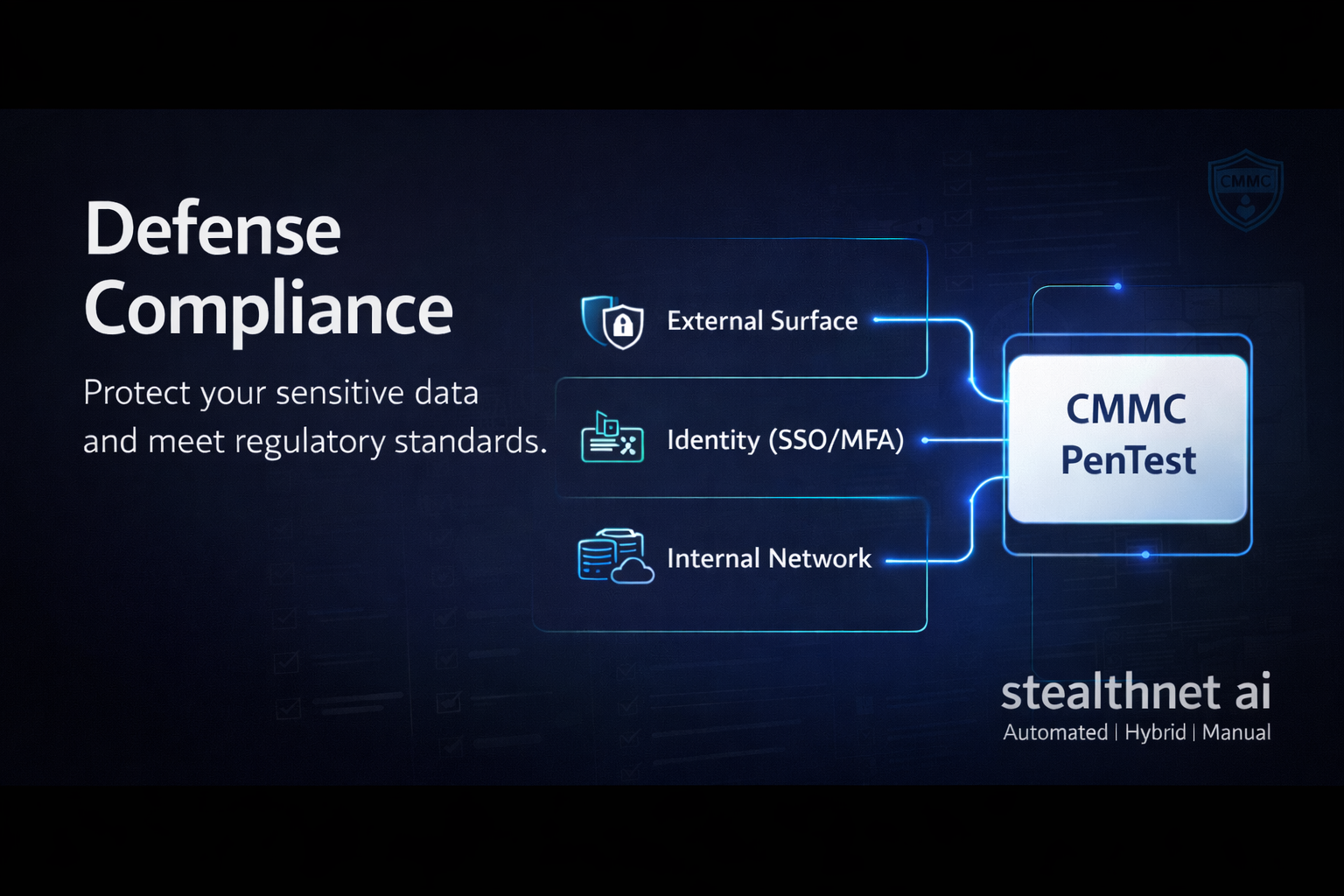
- Typical scope: the CUI enclave, external perimeter, identity systems, and segmentation between corporate IT and CUI environments
- A hybrid AI and human approach typically delivers the right balance of depth and turnaround
Level 3
- Aligned to NIST SP 800-172 and assessed only by DCSA
- Focused on resistance to advanced persistent threats and capable nation-state adversaries
- Deeper human-led testing expected, not just automated tooling
- Broader adversarial simulation including assumed-breach and lateral movement scenarios explicitly targeting CUI
- Fully manual engagements are recommended at this level to satisfy assessor expectations on testing depth
How C3PAO Assessors Evaluate Your Pentest Evidence
A C3PAO assessor reviewing your pentest report is not checking that the engagement happened. They are checking whether it was scoped correctly, whether it covered the attack paths an actual adversary would take, and whether the findings are documented with the evidence required to validate severity and remediation.
The first questions an experienced assessor asks: was the testing boundary aligned to the CUI assessment scope? Were realistic attack paths exercised rather than only network-level scans? Are findings documented with severity ratings, reproduction steps, and supporting evidence such as screenshots and logs? Was remediation verified through a retest before evidence was submitted?
The most common failure pattern is contractors submitting reports that read like vulnerability scan exports. There is no proof of exploitation, no narrative of attacker behavior, and no evidence package. To an assessor, that signals either an inexperienced testing vendor or a checkbox engagement, and either interpretation raises immediate concerns about the rest of the control set.
A C3PAO-ready report must include an executive summary written for leadership, technical findings with CVSS scores and reproduction steps, screenshots and logs as supporting evidence, prioritized remediation guidance, and a remediation verification summary from the included retest.
Scoping Your CMMC Pentest the Right Way
The fastest way to waste money on a CMMC pentest is to scope it like a generic test-everything engagement. The fastest way to miss what matters is to scope so narrowly that realistic attack paths into the enclave never get exercised. The right starting point is the CUI enclave boundary itself, expanded to include every pathway that could realistically reach it.
Scoping checklist:
- Define the CUI enclave boundary and document what is in scope
- Identify all internet-facing entry points that could reach the enclave
- Include identity paths: SSO, MFA enforcement, conditional access, and privileged roles
- Validate segmentation between corporate IT and CUI systems
- Include third-party and vendor integrations that touch the enclave
- Confirm rules of engagement, safety constraints, and test windows up front
Test surfaces that must be covered:
- External network: perimeter exposure and initial access vectors
- Assumed breach and internal: lateral movement and privilege escalation toward CUI
- Web application and API: authentication flaws, access control, data exposure, business logic
- Identity and SSO: misconfigurations, excessive privilege, MFA gaps
- Cloud and SaaS: permissions, storage exposure, logging gaps
- Segmentation validation: confirm out-of-scope systems cannot pivot into CUI systems
Need a CMMC pentest before your C3PAO assessment?
StealthNet AI delivers audit-ready reports in 48 hours with fixed-fee pricing. Most engagements start within 24 hours.
Get a Custom QuoteThe 5 Stages of a CMMC Pentest Engagement
- Planning and Scoping. Define the engagement goals, in-scope assets, boundary documentation, and rules of engagement. This stage determines whether the rest of the engagement produces useful evidence or wasted effort. Mistakes made here are expensive to fix later.
- Reconnaissance. Map the attack surface, identify realistic entry points, and profile the environment the way an attacker would before touching anything. Good reconnaissance is what separates targeted testing from random probing.
- Exploitation. Validate what is actually exploitable with documented proof. This is the stage that separates a penetration test from a vulnerability scan and is the evidence assessors care about most.
- Post-Exploitation. Determine the realistic blast radius and trace access paths toward CUI. This stage answers the question that matters most to assessors: does segmentation actually hold under pressure?
- Reporting and Retesting. Deliver findings with evidence, prioritized remediation guidance, and a retest to verify fixes are effective. The retest is non-negotiable for CMMC readiness, and a report without one is incomplete.
Common Mistakes That Sink CMMC Pentests
Most CMMC pentest failures trace back to a small set of preventable mistakes. The first is testing assets outside the CUI assessment scope because the vendor did not understand the enclave model. The second, more dangerous variant is scoping the enclave correctly but failing to test the pathways into it. The enclave is the destination. The pathways are how an attacker actually gets there, and skipping them produces a report that answers the wrong question.
The third recurring mistake is submitting a vulnerability scan export as a pentest report. Assessors notice immediately, and once that judgment is made, every other piece of evidence in your package gets scrutinized more aggressively. The fourth is having no retest plan, which leaves remediation work documented but never verified, undermining the credibility of the entire program.
Finally, contractors routinely schedule their pentest too close to the C3PAO assessment window. When critical findings surface with no time left to remediate, retest, and collect evidence, the assessment slides and the contract opportunity slides with it. Choosing a vendor with no CMMC-specific experience compounds all of these problems, because a generic MSP or scanner tool is not a substitute for a qualified offensive security team that understands defense-sector compliance.
How to Time Your Pentest Around the C3PAO Assessment Window
The minimum recommended lead time is 90 days before your C3PAO assessment date. That window provides enough room to remediate critical findings, complete a retest, and have verified evidence ready when assessors arrive. Shorter timelines work in theory and fail in practice the moment a high-severity finding surfaces late in the engagement.
Once initial certification is achieved, the testing cadence shifts to a sustaining rhythm:
- Annually: a full-scope pentest of the CUI enclave and the pathways into it
- After major changes: cloud migrations, identity changes, new applications, network redesigns
- Quarterly targeted tests: high-change surfaces like web applications, APIs, and identity policies
Contractors anticipating frequent changes benefit from a continuous AI-assisted model, which reduces surprises between formal assessments and keeps posture closer to audit-ready year-round.
Why AI-Assisted Pentesting Accelerates CMMC Readiness
Traditional pentesting timelines of two to four weeks were built for environments that change slowly. The pace of change inside a defense contractor preparing for assessment is much faster, and a multi-week engagement window often misses the configuration state the assessor will eventually review.
AI-assisted pentesting compresses the discovery and exploitation phases and delivers initial findings within 48 hours. The hybrid AI and human model is the right fit for Level 2 readiness: AI agents handle broad surface coverage at scale, while senior human testers focus on complex attack chains, identity abuse, and business logic. Every AI-discovered finding is validated by a human before it lands in the report.
For Level 3 environments where the threat model assumes capable adversaries, fully manual human-led engagements remain the right choice. The shared benefit across both models is the same: faster findings translate directly into more time for remediation before the assessment window closes.
Get a CMMC-Ready Pentest Report in 48 Hours
StealthNet AI delivers CMMC penetration testing in three engagement models, each aligned to the assessment requirements and timeline of the contractor we are working with.
- AI-Only. Fast, repeatable coverage for validating external exposure and key access paths. Best used for continuous validation between formal assessments.
- Hybrid AI and Human. Broad automated coverage combined with senior human testers who validate exploitability, chain weaknesses, and produce high-confidence findings with full evidence. Recommended for CMMC Level 2 readiness.
- Fully Manual. Deep human-led testing for Level 3 environments and higher-assurance requirements where adversarial simulation depth is the priority.
Every report includes an executive summary, CVSS-scored findings, screenshots and logs as evidence, remediation guidance, and a remediation verification summary from the included retest. Testing is performed exclusively by US-based senior testers holding OSCP, OSCE³, and CRTO certifications. Most engagements start within 24 hours of scoping.