
Quote in 48 hours
Get a custom quote
Fixed-fee scoping in 24 hours. No sales pitch.
AI Vulnerability Scanners vs. AI Pentesting (2026)
Last updated: August 5, 2026 | By Alex Thomas | Technical review: Eren Akdora
We have been hearing the same question more often from security teams, compliance leaders, and even customers already shopping for a penetration test: “Is AI pentesting basically a smarter vulnerability scan?”
The short answer is no—but the confusion is understandable. Some vendors use AI vulnerability scanner to describe a conventional scanner with better prioritization. Others use the same phrase for systems that analyze code or cloud context. A third group uses it for autonomous agents that interact with a live target, test hypotheses, validate exploits, and chain weaknesses together. Those are materially different capabilities hiding behind one label.
The quick answer
An AI vulnerability scanner automates the discovery, analysis, and prioritization of possible security weaknesses. It is strongest at broad, frequent coverage: finding known CVEs, missing patches, exposed services, misconfigurations, suspicious code patterns, or risky relationships across assets.
AI pentesting goes beyond detection. An AI pentesting agent can observe how a target behaves, form a hypothesis, execute an authorized test, interpret the response, change its approach, and collect evidence that a weakness is actually exploitable. A well-designed system can also investigate whether several individually minor weaknesses form a meaningful attack path.
The best security program is not “scanner or pentest.” It uses scanning for continuous breadth, AI agents for adaptive depth, and human expertise for safety, business logic, and defensible conclusions.
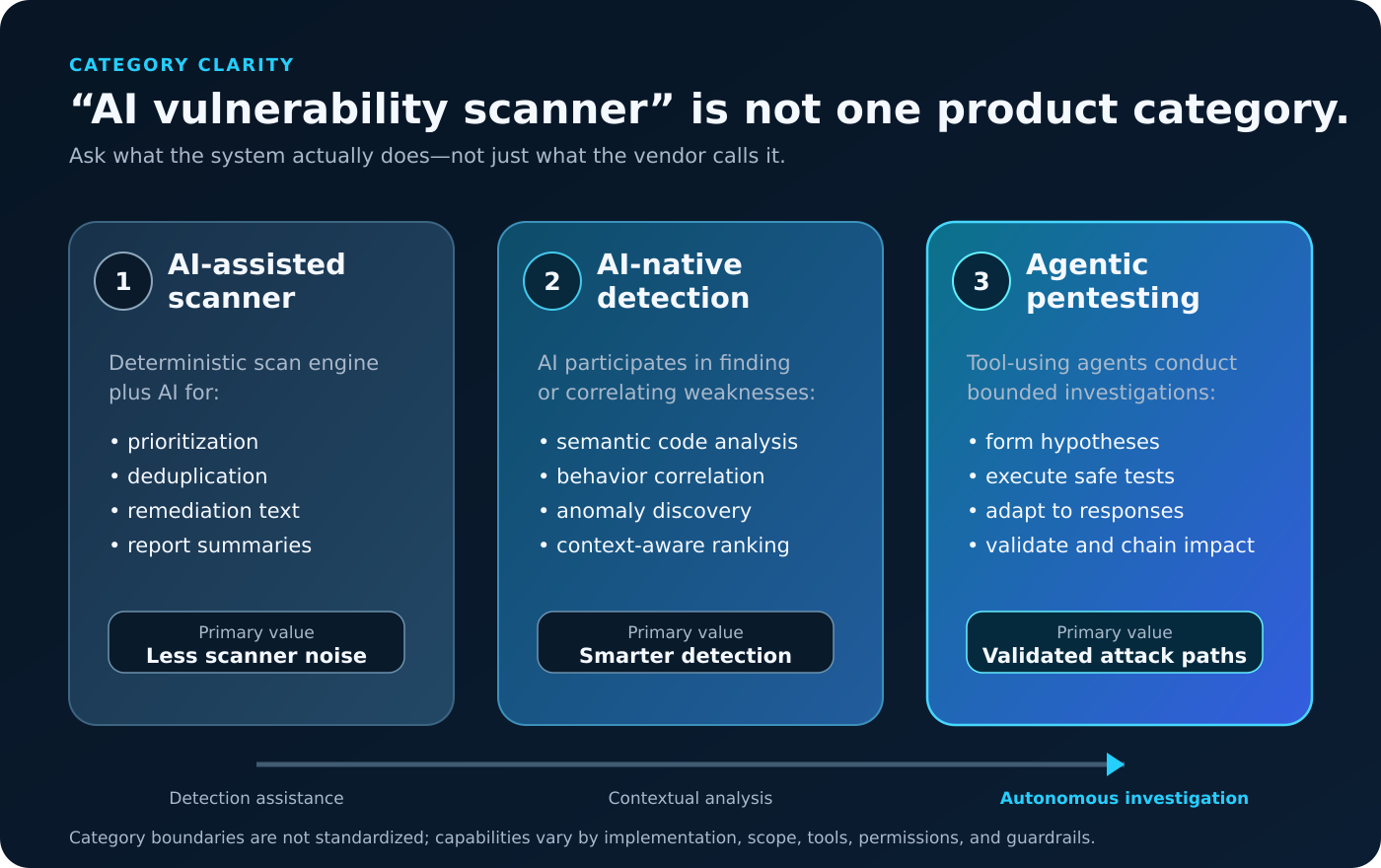
Figure 1. “AI vulnerability scanner” is not a standardized product category. Buyers should evaluate what the system actually does.
What is an AI vulnerability scanner?
An AI vulnerability scanner is a security tool that uses artificial intelligence somewhere in the process of finding, analyzing, prioritizing, or explaining vulnerabilities. That definition is intentionally broad because the market currently uses the term in at least three ways.
1. A traditional scanner with AI assistance
In the first model, the underlying scanner remains deterministic. It fingerprints a service, checks a version, matches a signature, analyzes a configuration, or sends a predefined test. AI is then used to group duplicates, enrich findings, write remediation guidance, summarize results, or improve prioritization.
This is useful. Security teams rarely need another longer list; they need a shorter, clearer queue. But AI-generated explanations do not automatically make the underlying finding exploit-validated.
2. AI-native vulnerability detection
In the second model, AI participates in detection. It may analyze code semantically, infer relationships across code and cloud infrastructure, identify anomalous behavior, or correlate identity, network, and data context. These systems can recognize risk that an exact signature might miss and may predict whether a finding is reachable or likely exploitable.
Prediction is not the same as proof. A strong prediction can improve triage, but it still tells you what may happen unless the system safely reproduces the security impact.
3. Agentic penetration testing
In the third model, tool-using AI agents conduct a bounded investigation. They interact with a running application, API, network, or cloud environment; decide what to test next; execute permitted actions; interpret new evidence; and adapt. The goal is not only to label a weakness but to determine what an attacker could actually achieve.
This third category is better described as AI pentesting, agentic penetration testing, or autonomous security validation. Calling it scanning understates the central capability: an iterative test-and-learn loop.
There is a second source of ambiguity, too. “AI vulnerability scanner” can mean a scanner powered by AI, or a tool used to scan AI systems such as models, retrieval pipelines, and agents. Those functions can overlap, but they are not interchangeable. A buyer should ask which assets, vulnerability classes, and testing methods are truly supported.
What is vulnerability scanning?
Vulnerability scanning is an automated process for identifying potential weaknesses across hosts, applications, networks, cloud resources, or other assets. Depending on the tool, it can detect outdated software, missing patches, exposed services, insecure configurations, known vulnerable components, and common application flaws.
The NIST Technical Guide to Information Security Testing and Assessment describes scanners as matching observed operating systems and software against known vulnerability information. NIST also emphasizes both their value and their limits: scanners are fast at quantifying surface exposure, but risk often depends on context and combinations of weaknesses that a signature-driven tool may not recognize.
That is why vulnerability scanning remains foundational. It is repeatable, scalable, relatively inexpensive per asset, and suitable for frequent testing. It answers questions such as:
What assets and services are exposed?
Which software versions have known vulnerabilities?
Which systems are missing patches or violate a configuration policy?
What changed since the last scan?
Which findings should enter the vulnerability-management backlog?
Scanning is excellent for broad security hygiene. The mistake is treating a complete scan as proof that no exploitable path exists.
What is AI pentesting?
AI pentesting uses AI systems often agents with access to security tools, browsers, terminals, or API clients—to perform parts of a penetration test. The system can plan, execute, observe, and adapt inside an authorized scope and defined rules of engagement.
NIST defines penetration testing around simulated real-world attacks and the search for combinations of vulnerabilities that create more access than a single weakness would provide. Its penetration testing methodology moves through planning, discovery, attack, and reporting. An AI agent can automate meaningful parts of discovery and attack while maintaining state across the engagement.
The important distinction is behavior. A scanner usually executes a predetermined family of checks. An agent selects its next action based on what happened previously.
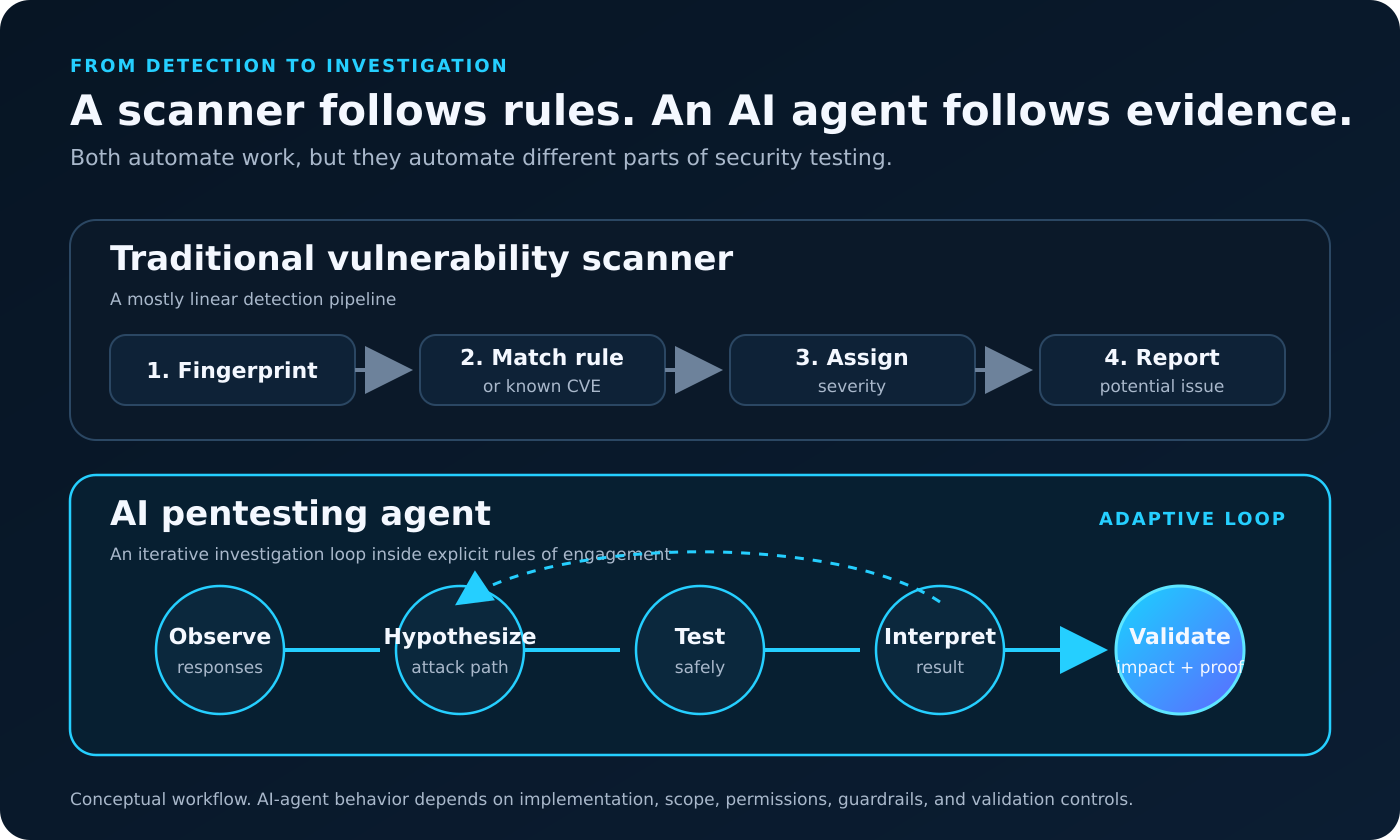
Figure 2. Traditional scanning is primarily a detection pipeline. Agentic pentesting is an iterative investigation loop.
An AI pentesting system may:
Map reachable pages, endpoints, services, roles, and trust boundaries.
Build hypotheses from observed behavior rather than only known signatures.
Execute a controlled test permitted by the rules of engagement.
Interpret the target’s response and distinguish an error from real security impact.
Change tools or techniques when the evidence does not support the original hypothesis.
Validate exploitability and capture reproducible, redacted proof.
Explore whether one weakness enables another, within agreed stopping conditions.
Generate remediation guidance connected to the validated attack path.
This does not make every AI agent a competent pentester. Architecture, model quality, tools, memory, guardrails, target access, and validation all matter. “Uses AI” is not a test methodology.
AI vulnerability scanner vs. AI pentesting: the key differences
The clearest comparison is the question each method is designed to answer.
Dimension | AI vulnerability scanner | AI pentesting | Hybrid AI + human pentest |
|---|---|---|---|
Primary question | What weaknesses might exist? | What can be exploited? | What matters, and is the conclusion defensible? |
Typical process | Discover, match or infer, rank, report | Observe, hypothesize, act, interpret, adapt, validate | AI-led coverage plus human exploration and review |
Breadth | Excellent across large asset sets | Broad, then deeper where evidence leads | Broad coverage with targeted expert depth |
Known CVEs and misconfigurations | Core strength | Usually part of discovery | Included as an input to deeper testing |
Business logic | Often limited; varies by product | Can test modeled workflows when context and identities are available | Strongest option for bespoke workflows |
Exploit validation | Sometimes predicted; sometimes tested | Central objective | Human-verified validation |
Attack chaining | Usually correlation or predicted paths | Can execute controlled multi-step paths | AI chaining plus manual creativity |
Output | Findings, scores, affected assets, remediation | Reproduction evidence, impact, attack path, remediation | Reviewed evidence and audit-ready narrative |
Frequency | Continuous, weekly, monthly, or after change | On demand, scheduled, or continuous | Continuous automation plus milestone-based expert testing |
Best fit | Exposure management and security hygiene | Repeatable validation and deeper application/API testing | High-risk, bespoke, or compliance-facing environments |
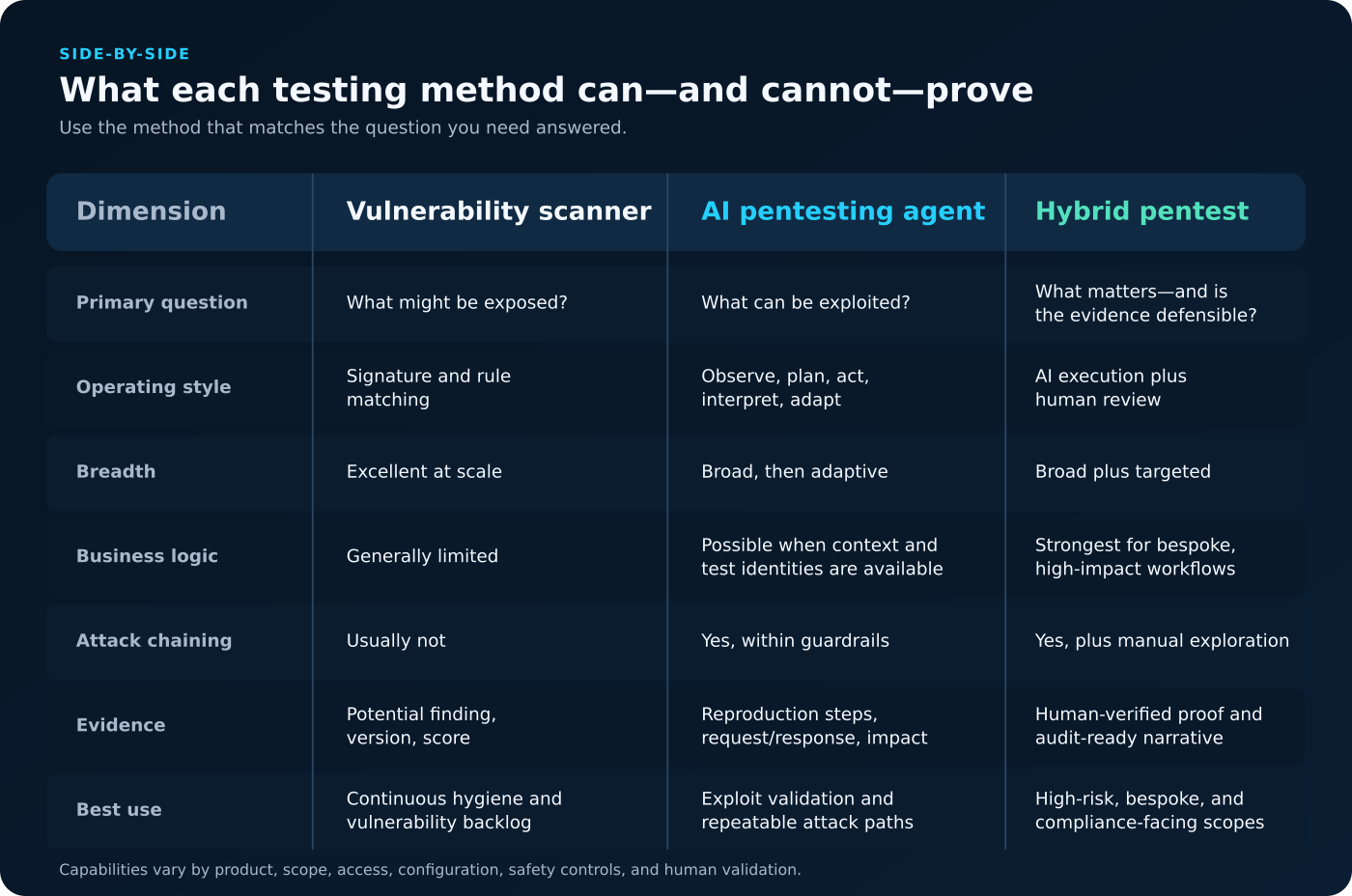
Figure 3. Capabilities vary by implementation, so buyers should verify these behaviors during a proof of concept.
Detection, prediction, and validation are not synonyms
This distinction matters when evaluating almost every AI security claim:
Detection means the system observed a signal associated with a weakness.
Prediction means the system inferred that a weakness is likely reachable or exploitable from available context.
Validation means an authorized test produced evidence of the expected security impact.
All three are valuable. Only the third establishes that the tested path worked under the conditions of the assessment. A report should make clear which standard of evidence applies to each finding.
Why this difference matters more in 2026
The volume of potential issues is rising, but alert volume is not the same as risk reduction. The 2026 Verizon Data Breach Investigations Report executive summary found that exploitation of vulnerabilities became the most common known initial access vector in its reporting dataset, accounting for 31% of breaches compared with 13% for credential abuse.
The same report found that only 26% of critical vulnerabilities—defined there as vulnerabilities in CISA’s Known Exploited Vulnerabilities catalog—were fully remediated by organizations in 2025. Median time to full resolution increased to 43 days from 32 days in the prior dataset. CISA recommends using the KEV catalog as an input to vulnerability-management prioritization because those vulnerabilities have evidence of exploitation in the wild.
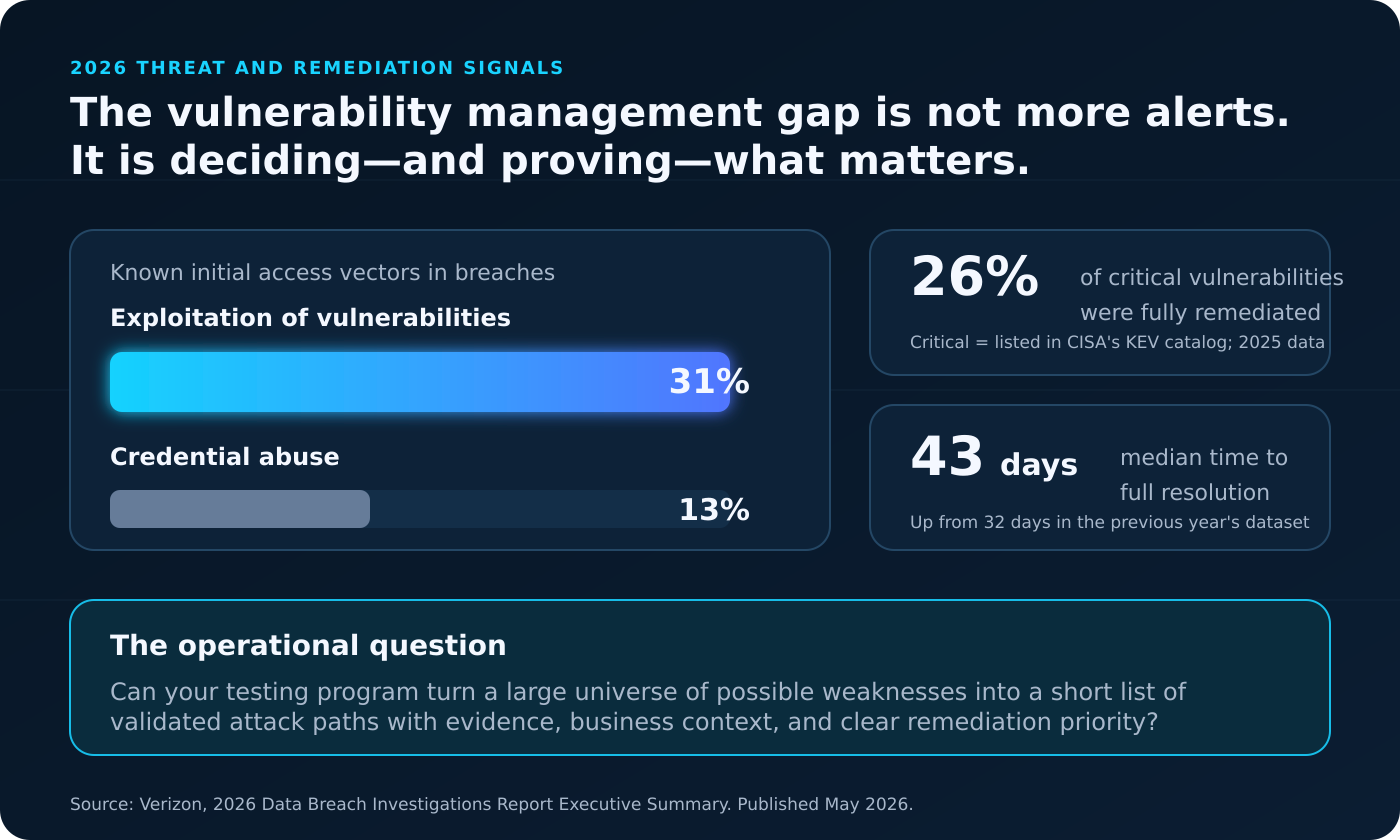
Figure 4. Current breach and remediation data shows why prioritization must move beyond raw severity.
This is the operational gap AI pentesting is designed to narrow. A scanner can tell a team that hundreds or thousands of possible weaknesses exist. Adaptive testing can help reduce that universe to a smaller set of paths that have evidence, reachability, and measurable impact.
It does not follow that only validated findings deserve remediation. An unexploited flaw may still be dangerous, and safe testing often stops before maximum impact. The point is that validation adds a stronger prioritization signal—it does not erase good vulnerability management.
A concrete example: cross-tenant API authorization
Consider a multi-tenant SaaS application with two test accounts supplied for an assessment. Each account belongs to a different tenant and can retrieve invoice records through the same API.
A conventional scanner can authenticate, crawl the API, identify the endpoint, and test common input-validation patterns. It may see a normal 200 OK response and no known CVE. Unless it understands who owns each object and deliberately compares authorization across identities, the request can look legitimate.
An AI pentesting agent can take a different path:
Map the two test identities, their tenants, and the invoice objects each account is authorized to access.
Form a hypothesis that object authorization may rely only on the invoice identifier.
Replay an authorized read request using the other tenant’s test identity.
Compare status codes, response shape, record ownership, and redacted data markers.
If cross-tenant access is confirmed, stop before modifying records or accessing unnecessary data.
Capture the minimal redacted request-and-response evidence needed to reproduce the issue.
Check whether an adjacent export or download function shares the same authorization control, if the rules of engagement permit it.
The resulting finding is not merely “possible broken access control.” It identifies the affected role, trust boundary, tested object, reproducible impact, and likely control failure. That is much closer to the evidence a developer, security leader, or auditor needs to make a decision.
OWASP’s Web Security Testing Guide section on business logic explains why these flaws have historically resisted conventional scanning: they depend on the intended business process and require unconventional test sequences. AI agents can automate more of this exploration than legacy scanners, but only when the system receives the necessary application context, test identities, and safe operating boundaries.
Can AI pentesting find attack chains that scanners miss?
Potentially, yes. NIST notes that several low-risk vulnerabilities can create a higher combined risk and that scanners can struggle with the enormous number of possible attack-pattern combinations. An AI agent can maintain a working model of discovered assets, privileges, sessions, and prior results, then use that state to select the next test.
For example, an individually modest information disclosure might reveal an internal service name. A second configuration weakness might make that service reachable. A third authorization flaw might expose a privileged function. A scanner could report three separate findings—or miss one entirely—while an adaptive test can investigate whether the sequence produces a meaningful outcome.
There are limits. The agent must preserve context across a long task, interpret tool output correctly, avoid circular exploration, respect stopping conditions, and distinguish coincidence from causation. Attack chaining is a capability to verify, not a phrase to accept on a sales page.
What the research says about AI pentesting
Academic results show real progress, but they also argue against treating every autonomous system as a finished replacement for expert testers.
The 2024 USENIX Security paper PentestGPT introduced a benchmark with 182 penetration-testing subtasks. Its modular system substantially improved task completion over the paper’s base-model comparison, while the authors also documented a core weakness: general-purpose language models struggled to maintain an integrated understanding of longer testing scenarios.
The Stanford Center for Research on Foundation Models’ Cybench evaluation tested agents on 40 professional-level capture-the-flag tasks. The best unguided result reported in that evaluation was 17.5%, and agents struggled as task difficulty increased. That is a useful reminder that success on short, well-bounded tests does not guarantee end-to-end competence.
More recent results show how quickly the field is moving. A study revised in March 2026, Comparing AI Agents to Cybersecurity Professionals in Real-World Penetration Testing, evaluated 10 professionals and several AI systems on a live university network of roughly 8,000 hosts. The researchers’ ARTEMIS system placed second overall, found nine valid vulnerabilities, and achieved an 82% valid-submission rate. At the same time, the study found higher false-positive rates and difficulty with graphical-interface tasks, and several other agent frameworks underperformed most human participants.
These studies are not directly comparable—the environments, agents, models, and success criteria differ. Together, however, they support a practical conclusion: AI agents can already provide meaningful autonomous security-testing value, but system design and human oversight still separate a useful pentesting product from an impressive demo.
Where AI vulnerability scanners remain the better tool
AI pentesting is not the answer to every security question. A vulnerability scanner is usually the better operational choice when the goal is:
Maintaining a continuously updated asset and service inventory.
Finding known CVEs, missing patches, and policy deviations across a large environment.
Running lightweight checks after every deployment or infrastructure change.
Monitoring thousands of lower-risk assets at a predictable cost.
Feeding a vulnerability-management workflow with normalized findings.
Meeting a requirement that specifically calls for vulnerability scanning.
Scanners are also valuable inputs to penetration testing. Discovery results, version data, and known-vulnerability matches help an agent or human tester decide where deeper investigation is warranted.
Where AI pentesting adds the most value
AI pentesting becomes more valuable when the organization needs to answer a question that requires interaction or proof:
Can this access-control weakness expose another customer’s data?
Is the suspected injection actually reachable through the deployed application?
Can two medium-severity weaknesses be combined into a critical path?
Does a compensating control block the exploit in practice?
Did a remediation close the original path without leaving an equivalent bypass?
Can testing produce reproducible evidence for a security review or customer request?
Agentic testing is especially attractive for web applications and APIs that change frequently. It can provide more depth than a traditional scan without waiting for every investigation to be performed manually. For high-risk or unusual environments, a hybrid model gives the agent broad execution capacity while a senior tester focuses on business logic, safety, and impact.
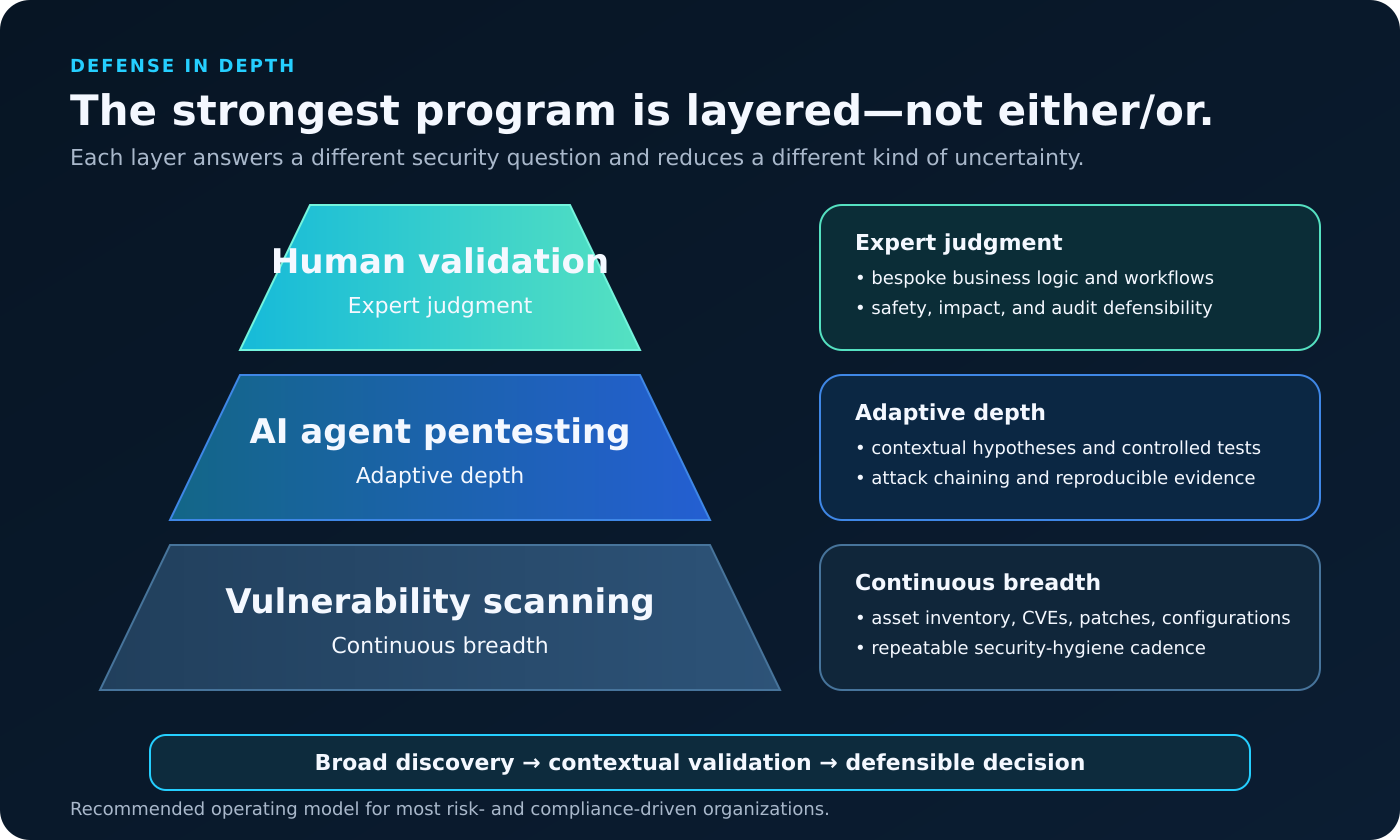
Figure 5. Scanning, agentic testing, and expert review are complementary layers.
Does an AI vulnerability scan count as a penetration test?
Not automatically. The name of the product matters less than the methodology, scope, actions performed, evidence produced, tester independence, and applicable requirement.
PCI DSS makes the distinction especially clear. In PCI DSS v4.x, vulnerability scanning sits under Requirement 11.3, while external and internal penetration testing sits under Requirement 11.4. The PCI Security Standards Council’s penetration testing guidance distinguishes a scan that identifies and ranks potential vulnerabilities from a penetration test that attempts to circumvent security controls and documents how an issue can be exploited. Organizations should confirm the current standard and scope with their assessor.
For other frameworks and customer-security reviews, acceptance depends on the requirement and the party reviewing the evidence. A strong AI or hybrid pentest should still define scope, methodology, rules of engagement, tester or reviewer qualifications, findings, evidence, risk, remediation, and retest results. Never assume that adding AI—or adding the word pentest—makes a deliverable audit-ready.
Risks and limitations of AI pentesting
AI agents introduce their own risks. A buyer should expect clear controls for all of the following:
False positives and false confidence
An agent can misread a response, hallucinate a conclusion, or confuse an application error with successful exploitation. Findings should be grounded in retained evidence and independently reproducible. High-impact reports benefit from senior tester validation.
Unsafe autonomy
The system must operate under explicit authorization, asset boundaries, rate limits, prohibited actions, test windows, and stop conditions. Destructive actions, denial-of-service techniques, persistence, and unnecessary data access should be disabled unless separately approved.
Long-horizon context loss
Agents can forget earlier evidence, repeat failed actions, or pursue an invalid hypothesis. Strong implementations use structured state, tool-output parsing, checkpoints, and verification—not only a long chat transcript.
Incomplete application context
An agent cannot reliably test a business rule it does not know exists. Role definitions, test accounts, API specifications, architecture context, and representative workflows materially improve coverage.
Data handling and model governance
Security testing can expose source code, credentials, request bodies, system details, or sensitive test data. Buyers should understand data residency, retention, model-provider access, tenant isolation, encryption, logging, and whether customer data is used for training.
Benchmark overfitting
Performance on capture-the-flag challenges or seeded vulnerabilities does not prove production effectiveness. Ask for results on representative assets, evidence quality, false-positive handling, and safe failure behavior.
How to evaluate an AI vulnerability scanner or AI pentesting platform
Use a proof of concept that measures outcomes, not the number of AI features in a demo. Teams building a shortlist can also use StealthNet’s AI penetration testing platform comparison. Ask:
What does the AI actually do? Is it summarizing scanner output, detecting vulnerabilities, planning tests, operating tools, or validating exploits?
Can it show the difference between detected, predicted, and validated findings? The report should label the evidence standard.
Can it test authenticated and multi-role workflows? Ask it to demonstrate isolation between two supplied test identities.
Does it adapt? When a test fails, can the system interpret why and choose a justified next action?
Can it validate impact safely? Require minimal proof, redaction, and explicit stopping conditions.
Can it investigate attack chains? Ask for the evidence connecting each step, not only a graph visualization.
How does it handle business logic? Determine what context and workflow definitions are required.
What are the guardrails? Review authorization, scope enforcement, rate limits, prohibited actions, approval gates, and kill-switch behavior.
What does a human review? Identify when a senior tester validates findings, explores manually, or signs the final report.
Is the output usable? Look for reproducible steps, request-and-response evidence, affected assets, business impact, remediation, and retesting.
How is sensitive data handled? Review residency, retention, model usage, encryption, isolation, and credential controls.
Will the deliverable satisfy the real requirement? Confirm with the auditor, QSA, customer, or internal policy owner when compliance is involved.
The next generation of vulnerability scanning is a testing stack
The future is not a vulnerability scanner with a chatbot attached. It is a layered system that combines deterministic coverage, AI-native analysis, agentic investigation, and expert judgment.
Scanners will continue to do what they do best: cover large environments frequently and surface possible weaknesses. AI will make that process more contextual and less noisy. Pentesting agents will increasingly investigate which paths work, collect evidence, and revalidate fixes. Human testers will remain essential where business logic is bespoke, safety matters, and the conclusion must withstand scrutiny.
That is why AI pentesting should be understood as the next automation layer above vulnerability scanning—not a reason to abandon scanning altogether.
At StealthNet AI, autonomous agents perform machine-speed discovery and controlled exploit validation, while hybrid engagements add senior U.S.-based penetration testers for business logic, false-positive review, and audit-ready reporting. If your current scanner produces a backlog but cannot tell you what an attacker can actually do, explore the StealthNet AI pentesting platform or request a scoped pentest.
Frequently asked questions
What is the difference between an AI vulnerability scanner and AI pentesting?
An AI vulnerability scanner primarily finds, correlates, and prioritizes possible weaknesses. AI pentesting interacts with the target, adapts based on responses, and attempts to validate what can actually be exploited within authorized boundaries.
Is an AI vulnerability scanner just a traditional scanner with ChatGPT?
Sometimes the AI layer is limited to summaries, prioritization, or remediation text. More advanced products use AI in detection, correlation, or autonomous testing. Buyers should ask what actions the system performs and what evidence supports each finding.
Can AI pentesting replace vulnerability scanning?
No. Scanning remains the efficient way to maintain broad, frequent coverage for known vulnerabilities, patches, exposed services, and configuration drift. AI pentesting adds adaptive investigation and exploit validation.
Can AI pentesting replace human pentesters?
AI agents can automate substantial parts of discovery, exploitation, evidence collection, and retesting. Humans remain valuable for bespoke business logic, ambiguous results, creative exploration, safety decisions, and compliance-facing validation. For many organizations, hybrid testing is the strongest current model.
Does a vulnerability scan count as a penetration test?
Usually not. A scan identifies potential weaknesses; a penetration test attempts to validate how security controls can be circumvented and what impact is possible. The applicable standard, scope, methodology, and evidence determine acceptance.
How often should vulnerability scanning and AI pentesting run?
Scanning commonly runs continuously, weekly, monthly, or after significant changes. Pentesting is often performed annually for assurance and compliance, after material changes, before major releases, or continuously for high-value applications. Frequency should follow risk and applicable requirements.
Can AI vulnerability scanners find business logic flaws?
Some AI-native and agentic systems can test business logic when they have application context, authenticated test identities, and modeled workflows. A generic scanner without that context is unlikely to understand the intended business rule. Human review remains important for novel or high-impact logic.
What should an AI pentest report include?
It should include scope, methodology, rules of engagement, tested assets and roles, findings, evidence, exploitability and business impact, severity rationale, remediation guidance, limitations, reviewer qualifications where applicable, and retest status.
Sources and further reading
NIST SP 800-115: Technical Guide to Information Security Testing and Assessment
OWASP Web Security Testing Guide: Introduction to Business Logic Testing
PCI Security Standards Council: Penetration Testing Guidance
Verizon 2026 Data Breach Investigations Report Executive Summary
Comparing AI Agents to Cybersecurity Professionals in Real-World Penetration Testing